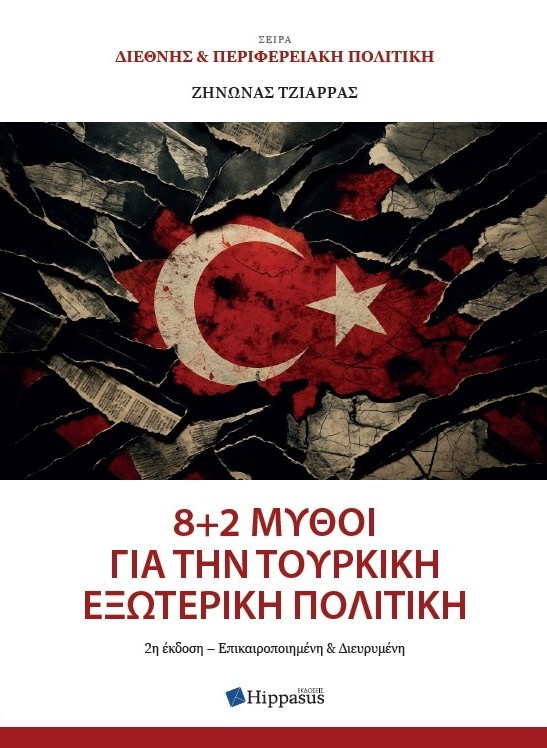
This month we present the book “8+2 Myths about Turkish Foreign Policy”, by Dr. Zenonas Tziarras.
Publisher: Hippasus
Publication Year: 2025
Description and central argument of the book
Despite the importance of global and regional developments and the seriousness of the Turkish challenge, the perception and analysis of Turkey in the Greek public sphere often suffer from misinterpretations, narratives, prejudices, and in general myths that either exaggerate or underestimate the country’s capabilities and role. The book 8+2 Myths about Turkish Foreign Policy offers a concise examination of ten key myths. Most of these can be found in public discourse in Greece and Cyprus. A small number relates to the Turkish narrative about its own foreign policy, while the selection of topics is based on traditional or contemporary issues that emerge in Greek and international literature as well as in public debate. What is needed is a perspective that is not limited by the Greek or Cypriot lens, but one that takes into account Turkey’s broader internal and external realities.
Contribution to the bibliography
Primarily, the book seeks to contribute to the public discussion surrounding the major issue of Turkish foreign policy more broadly. More specifically, it aims to offer all interested audiences a perspective that differs from the usual pathways and stereotypes of analysis about Turkey, in order to broaden the horizons of thought, analysis, and decision-making.
Who is it intended for?
The book is written in simple language but with an academic tone and documentation. For this reason, it is addressed to academics and researchers, technocrats and individuals with political responsibility, as well as any citizen who wishes to be informed about current developments.
How is the book structured and what topics does it cover?
The book is divided into two parts and covers a total of ten myths concerning Turkish foreign policy. The first part includes eight myths found in the Greek context regarding Turkish foreign policy. For example, that Turkish foreign policy does not change, that it has always been revisionist, that it has overextended itself, etc. The second part addresses two myths that Turkey itself reproduces about its foreign policy—namely, that it can lead or dominate its wider neighbourhood, and that rejection by the European Union is responsible for its anti-Western and revisionist behaviour. The book’s conclusion summarizes these myths along with the corresponding truths for each, and also offers brief comments on the formulation of Cypriot and Greek foreign policy.
How did the writing of the book come about
The first edition of the book was published in 2022. Its expanded re-edition was published by Hippasus in Nicosia at the end of 2025. The writing of the book emerged from the author’s need, shaped through years of private and public discussions about Turkey as well as observation of public discourse. What was observed was that although Turkey is such an important subject for us and we should be understanding it holistically and in depth, what prevailed—and likely still prevails—was rather a stereotypical and shallow analysis of developments. This is to some extent natural in a geographical space like the Eastern Mediterranean (Cyprus and Greece), where specific narratives as well as certain—real or wishful—expectations regarding Turkey are reproduced. Yet although partially natural, it is not beneficial. At the same time, the author’s engagement with the subject often led to confronting and deconstructing strong Turkish narratives about Turkey, even before international audiences. Thus, the book summarizes a number of narratives from both categories, which the author considers to be true myths. Naturally, the list is not exhaustive but includes the most important ones, at least in the author’s judgment.